(Aircraft Structural Integrity Program)
=>
Home
Overview
The ASIP dates back to a
1950's Air Force publication on structural integrity requirements. It was known
from an early stage that ASIP was a vital program in prolonging the life and
ensuring the structural safety of all aircraft. Meetings began in the 1970's,
but it wasn't until 1984 that it was reshaped into the current conference
format. Incidents like the 1988 Aloha Flight 243 Air Disaster highlighted the
importance of ASIP requirements and the contributions of the ASIP community, to
preclude the recurrence of such tragedies in the future. The ASIP Conference
helps to accomplish this through the personal interactions of its attendees,
resulting in the exchange of vital ideas and technology.
--------------------- Presentation
Abstract ---------------------
Title: How to Assess the Impact
of Post-Buckling Load Redistribution on the Fatigue Life
From 2003 to 2005, RUAG Aerospace
performed a Full Scale Fatigue Test (FSFT) of the
F/A-18 fighter aircraft in order to validate the Swiss-specific structural
modifications implemented during the procurement phase of this aircraft.
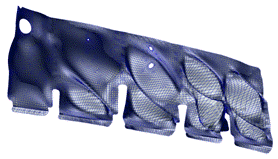
During this test, different shear
loaded webs suffered buckling. At some locations, the local stress increase due to post-buckling led to early cracks. Most of
these cracks grew along the radii of chemical-milled webs and eventually
reached significant lengths. Some of the longest cracks were found in fuel
tanks where the contact between cracked fuel barrier webs (deforming in the
out-of-plane direction) with the fuel cells could cause a major fuel leak.
After the completion of the test,
extensive fatigue analyses were performed to better understand these different
cracks. These complex analyses involved detailed Finite Element (FE) models run
with both linear buckling and general non-linear solutions. The in-plane load
fatigue spectra were then modified to account for the non-linearity of the
stress concentrations. The procedure for these analyses will be described in
detail in the presentation. The results of these studies closely matched the
FSFT findings.
Fatigue analyses allowed for the
optimization of preventive structural modifications to be incorporated in the
fleet aircraft. These structural improvements should prevent the occurrence of
early cracks and therefore, reduce maintenance costs. The modifications will be
applied during a structural refurbishment program. The benefits to the
structural integrity of the F/A-18 will then be explained.
Summary:
A method was developed to address
the impact of post-buckling on the fatigue behavior
of thin chemical-milled webs. Detailed FE-Models were developed in order to
determine the stress concentrations for every cycle of the master event
spectrum. These analyses led to very good results and will help to maintain the
structural integrity of the F/A-18 fighter in the future.
-----------------------------------------------------------------
|
|
Presentation |
|